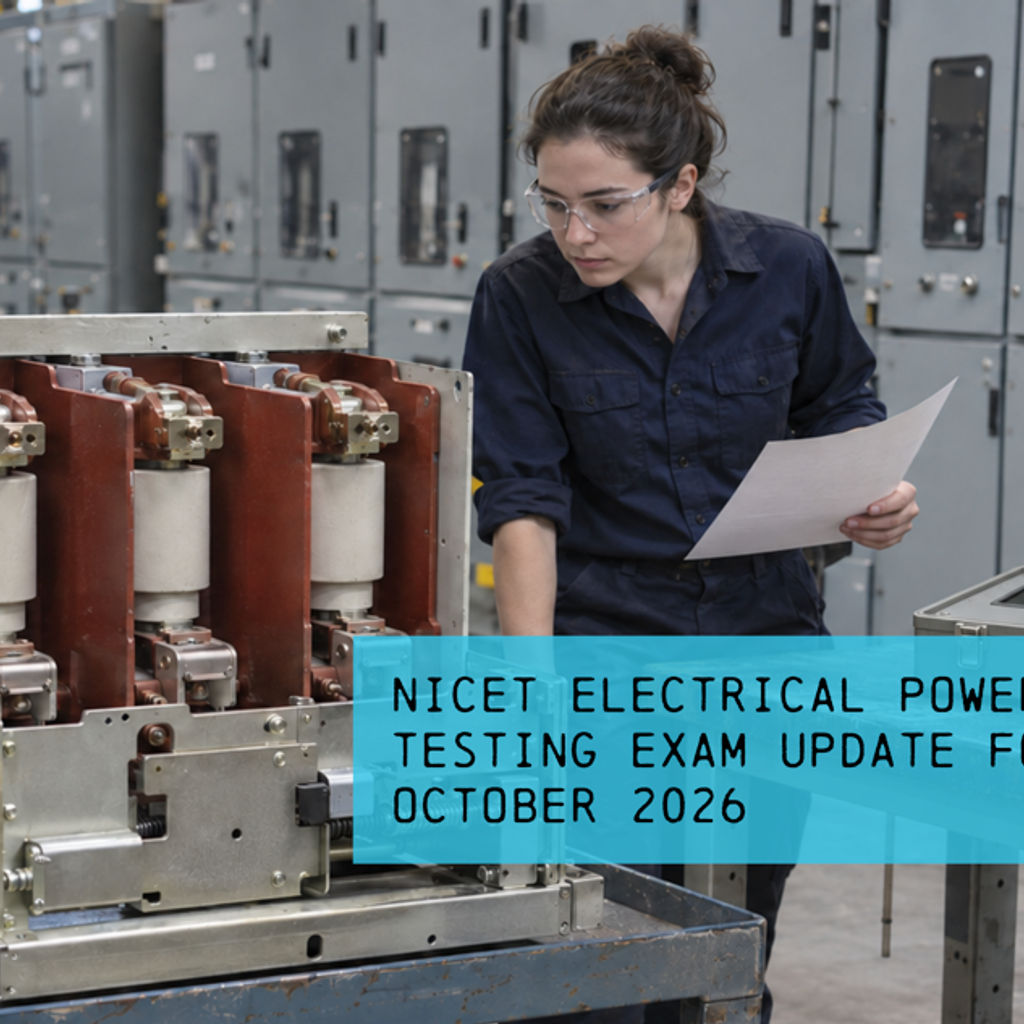



The NICET Electrical Power Testing exam update took effect on October 5, 2026, for Levels I, II, and III. The updated Level IV exam is scheduled for January 2027.
If you are studying for one of these exams, start by checking your materials against NICET’s current content outline and reference list. The outline explains which topics the exam covers. The reference list identifies publications that can help you study.
Older books and courses can still help explain electrical fundamentals. Check their topic coverage and reference editions before relying on them for your exam.
Which NICET Electrical Power Testing exams changed?
The updated exams are available for Levels I, II, and III. NICET lists these question counts and time limits on its Electrical Power Testing program page.
| Level | Updated exam release | Questions | Exam time |
|---|---|---|---|
| Level I | October 5, 2026 | 67 | 80 minutes |
| Level II | October 5, 2026 | 136 | 155 minutes |
| Level III | October 5, 2026 | 102 | 125 minutes |
| Level IV | Scheduled for January 2027 | Confirm with NICET | Confirm with NICET |
For the updated Level IV exam, confirm the format with NICET before scheduling. Do not assume the question count and time limit listed for the earlier exam will apply.
What the NICET Electrical Power Testing exam update covers
NICET divides each outline into topic groups called domains. Each domain has a percentage range showing how much of the exam it covers. Use those ranges to help plan your study time, while reviewing every task.
Level I: Learn safe work practices and electrical basics
The current Level I outline describes a trainee working under direct supervision. It covers electrical basics, safety, test instruments, and recording and communicating results.
Electrically Safe Work Conditions has the largest weighting range, at 18% to 28%. Workplace Safety accounts for 15% to 25%.
Give safety regular attention during your review. Study how to recognize hazards, understand lockout/tagout, and choose appropriate protective equipment. Lockout/tagout is the process used to control hazardous energy so equipment cannot be unexpectedly energized during work.
Also practice identifying common electrical equipment, working with basic electrical equations, selecting test instruments, and reading simple one-line diagrams. A one-line diagram uses symbols and single lines to show how power equipment connects.
For example, practice choosing an instrument for a stated task and explaining why it is suitable. Then practice recording the measurement with the correct units.
Level II: Connect test procedures with results
The current Level II outline describes a technician who performs and documents standard tests under limited supervision.
General Testing is the largest domain, at 32% to 42%. Safety Procedures accounts for 20% to 30%. Other topics include documentation, standards, electrical theory, and basic troubleshooting.
The equipment covered includes cables, transformers, motors and generators, switchgear, circuit breakers, relays, grounding systems, and batteries. The outline also calls for comparing results with standards or similar equipment.
For each test you review, connect its purpose with the setup, safety controls, measurements, and report.
For example, when studying a test of cable insulation, explain what the test checks, how the cable must be prepared, and what could affect the reading. Then identify what information belongs on the test report. This gives the test a practical context instead of leaving it as a name to memorize.
Level III: Practice planning and evaluating evidence
The current Level III outline covers seven domains. Advanced Testing/System Testing is the largest, at 21% to 31%. Evaluation of Test Results accounts for 13% to 23%.
Other areas include safety plans, job testing plans, electrical theory, documentation, and protection, control, and automation. The level description includes planning jobs, managing switching procedures, testing complex equipment, analyzing data, and leading a team.
Practice explaining what a result means and what information supports your decision.
For example, suppose a circuit breaker has a resistance reading higher than expected. Work through what you would check before judging its condition: the test connections, test conditions, previous readings, and results from comparable equipment.
Study system relationships, too. A protective relay detects specified electrical conditions and can command a circuit breaker to open. Review how the relay, control circuit, and breaker work together, along with how their operation is tested.
Check the reference editions for your level
NICET publishes separate selected general reference lists for Level I, Level II, and Level III.
Match both the publication and its edition to your level’s list. Do not assume the newest edition is the one NICET lists, or that every level uses the same edition.
For example, the current lists specify NFPA 70B (2023) for Level II and NFPA 70B (2026) for Level III. All three list NFPA 70 (2026) and NFPA 70E (2024).
The lists are study resources, not complete lists of everything that could appear on the exam.
Is the NICET EPT exam open book?
No. Candidates may not bring reference publications into the test center. Use the listed books and standards during preparation.
NICET provides an on-screen calculator. Personal calculators are not permitted in the testing room. Check the current exam instructions and your appointment information before test day.
How to adjust your study plan
- Use the current outline as a checklist. Go task by task and identify where your book, course, or notes cover each one. Mark any gaps.
- Check what you can explain without help. Recognizing a term is different from explaining a procedure, solving a problem, or interpreting a result.
- Give more time to weak areas and larger domains. Review every domain, but spend extra time where your knowledge gaps overlap with heavily tested topics.
- Review the reason behind each practice answer. When you miss a question, identify the concept or step you misunderstood. Study that point before trying another question on the same topic.
- Practice under the current time limit. Use the question count and exam time for your level to build a realistic practice session.
Check certification requirements separately from your study plan. Passing the exam is one requirement. NICET also reviews relevant work experience and performance verification. Levels III and IV require a personal recommendation.
Using Prime Systems Academy resources
Our NICET study guides, courses, and practice exams can help you review the topics in your level’s current outline. Use the lessons to work through unfamiliar concepts and the practice questions to identify where you need more study.
Start with the current NICET outline. Match your materials to its tasks, check the reference editions, and practice applying what you learn. That gives your preparation a clear direction for the updated exam.
Prime Systems Academy is an independent education provider and is not affiliated with, sponsored by, approved by, or endorsed by NICET. Its practice questions are original study materials, not actual NICET examination questions.