Finishing high school without a clear career plan is more common than people admit. You may know that you want a technical career, but not know what kind. You may have no electrical experience, no college degree, and no family connection that can get you into the industry.
Electrical power testing is one career worth knowing about.
Testing technicians work on the equipment that distributes and protects electrical power: transformers, circuit breakers, switchgear, cables, protective relays, grounding systems, batteries, motors, generators, and control systems. The work can eventually lead into protective relaying, commissioning, troubleshooting, field supervision, project management, and other specialized positions.
It is also a career where experience matters. You generally do not complete a short online course and become a qualified electrical testing technician. The normal path is to learn the fundamentals, get into the industry, work beside experienced technicians, build documented field experience, and gradually take responsibility for more complicated work.
NICET and NETA certifications can help document that progression, but the certification is only part of the career.
The real objective is becoming capable enough that an employer trusts you with increasingly difficult electrical power work.
What does an electrical testing technician do?
Large electrical systems contain much more than wiring and circuit breakers.
Hospitals, data centers, factories, utilities, military installations, commercial facilities, and generating plants may depend on transformers, medium-voltage switchgear, protective relays, instrument transformers, cables, station batteries, generators, motors, and other power equipment.
Before that equipment is placed into service, and periodically throughout its life, someone has to inspect it, test it, evaluate the results, and identify problems.
That is a large part of what electrical testing technicians do.
NICET describes Electrical Power Testing work as inspection, testing, maintenance, and evaluation of equipment associated with the production, transmission, and distribution of electrical power. Its program also covers electrical safety, theory, test procedures, protection, control, automation, and technical documentation.
This is different from most residential electrical work. Electrical power testing is generally centered on commercial, industrial, utility, and other power-distribution systems. NICET also notes that qualifying EPT experience is primarily associated with medium- and high-voltage equipment, with qualifying low-voltage experience generally concentrated around larger 480- to 600-volt systems.
A new technician might initially help connect test equipment, record readings, inspect equipment, and perform basic maintenance. An experienced technician may be planning outages, interpreting questionable results, testing protective relays, troubleshooting control circuits, performing switching, and directing other technicians.
The job grows with you.
Why consider electrical power testing as a career?
The most interesting part of this career is not where someone starts. It is where a good technician can eventually go.
The U.S. Bureau of Labor Statistics does not have a wage category specifically for NETA or NICET technicians. One of the closest occupations is Electrical and Electronics Repairers, Powerhouse, Substation, and Relay.
The May 2025 national median for that occupation was approximately $103,020 per year.
That does not mean a new technician should expect a six-figure income. The higher-paying positions normally come after years of experience and the development of skills such as medium-voltage testing, protective relaying, commissioning, troubleshooting, switching, test-data analysis, and leadership.
A better question for someone entering the field is therefore not, “How quickly can I make $100,000?”
It is, “What do I need to learn so that five or ten years from now I can do the work those positions require?”
That is what this career path is built around.
Start by building enough knowledge to be employable
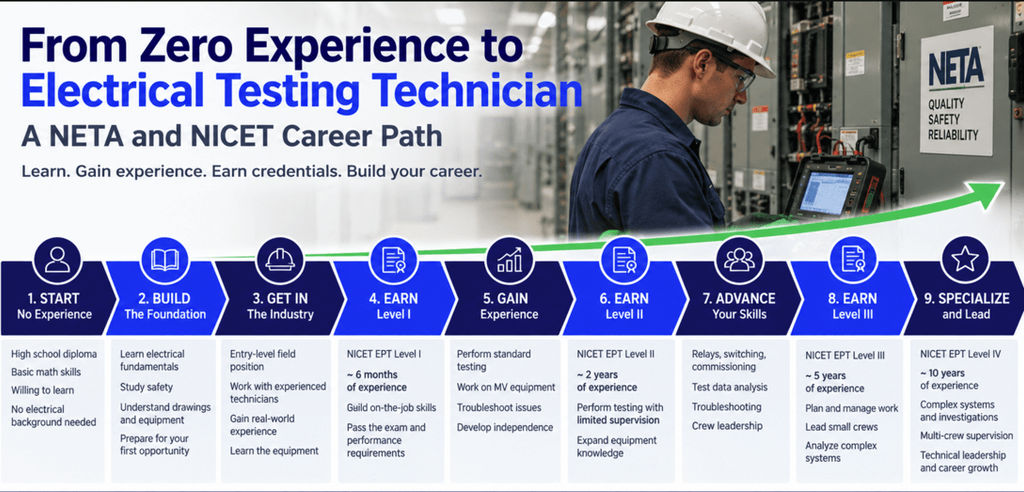
Someone coming directly out of high school does not need to understand protection engineering or advanced transformer diagnostics.
They do need a foundation.
Start with voltage, current, resistance, Ohm’s law, power, AC and DC circuits, single-phase and three-phase systems, frequency, basic magnetism, transformers, and power factor. The objective is not to become an engineer before applying for your first job. It is to understand enough electrical theory that the equipment and terminology you encounter begin to make sense.
Basic math belongs here too. Testing technicians routinely work with ratios, percentages, exponents, scientific notation, square roots, basic algebra, and electrical formulas. You do not have to love math, but you should become comfortable using it.
Safety should be learned at the same time.
A new technician needs an introduction to shock and arc-flash hazards, PPE, lockout/tagout, voltage identification, electrically safe work conditions, grounding concepts, and the basic rules for working around energized electrical equipment.
The current NICET Level I outline places substantial emphasis on safety, which is appropriate for someone just entering the field.
You should also begin learning how electrical information is presented. Practice reading equipment nameplates, one-line diagrams, basic schematics, wiring diagrams, electrical symbols, and manufacturer manuals.
You do not need to understand every line of a protection schematic yet. Being able to open a drawing and recognize what you are looking at is a good start.
Where Prime Systems Academy can fit at the beginning
This is one area where Prime Systems Academy can help someone who has not yet entered the industry.
A structured foundation could cover electrical fundamentals, math for electrical technicians, basic electronics, electrical power-system basics, safety, and drawing interpretation.
The purpose of that training should be clear: an online course does not turn someone with no field experience into a qualified electrical testing technician.
What it can do is shorten the learning curve.
A person who already understands basic three-phase power, recognizes a transformer nameplate, knows what a one-line diagram represents, and understands why electrical safety procedures exist will arrive at the first job better prepared to learn from the people around them.
That is a much more realistic role for introductory training.
The most important step is getting into the field
Once you understand the basics, the priority should shift toward getting actual electrical power experience.
Job titles vary considerably between companies, so do not search only for “NETA technician.”
Entry-level opportunities may appear under titles such as electrical test technician trainee, field service technician, substation technician trainee, commissioning technician, switchgear technician, transformer technician, or relay technician trainee.
The exact title matters less than the work you will be exposed to.
For someone early in the career, I would look closely at whether the position provides opportunities to work around transformers, breakers, switchgear, cables, grounding systems, control circuits, and protective equipment while learning from experienced technicians.
That can matter more over the first few years than a small difference in starting pay.
For example, one position might pay $27 or $28 per hour but keep a new employee doing the same narrow task every day. Another might pay a few dollars less while putting that technician beside experienced people testing transformers, circuit breakers, switchgear, and protective devices.
There is nothing wrong with considering pay. You still have bills to pay.
But early in the career, you should also ask what the job will teach you.
NICET Level I can provide an early milestone
NICET’s Electrical Power Testing Level I can provide a relatively early objective after entering the field.
The source material for this article identifies a minimum of six months of full-time experience supporting electrical power equipment testing and maintenance, with limited substitution from related electrical power work. Candidates also have examination and performance-verification requirements.
The Level I performance expectations include basic field abilities such as responding to jobsite safety information, recognizing hazards, using PPE, identifying equipment voltage, connecting equipment for basic measurements, following testing instructions, and assisting with common apparatus testing.
That makes Level I a reasonable first credential for someone already working in the industry.
The important distinction is that the credential follows the beginning of field experience. It should not be treated as a replacement for getting the field experience in the first place.
The first two years should be about learning equipment
Around the first couple of years, a technician should be moving from assisting with testing toward performing more standard work with less supervision.
The article’s source material identifies two years of qualifying full-time experience for NICET Level II and describes Level II technicians as performing standard testing on basic equipment under limited supervision.
This period is where equipment knowledge starts to matter.
With transformers, learn the basic construction, winding connections, ratios, grounding, insulation systems, and common field tests.
With circuit breakers, learn how the mechanism operates, what the contacts do, how insulation and control circuits are arranged, and why technicians perform contact resistance, insulation, timing, and other tests.
Learn how switchgear is put together, including buses, breakers, compartments, controls, shutters, interlocks, and grounding provisions.
Get exposure to cables, grounding systems, batteries and chargers, CTs, PTs, and basic control power.
The biggest improvement you can make during this period is learning the reason behind the test instead of memorizing only the steps.
If you are performing a transformer turns-ratio test, understand what ratio you are verifying and what could cause the measured ratio to be wrong. If you are measuring breaker contact resistance, understand what current path you are evaluating and why a poor connection matters.
That habit becomes increasingly important as the testing gets more complicated.
Online training and field experience should complement each other
A good learning path during the first few years could combine structured study with whatever equipment the technician is seeing at work.
That might include electrical testing fundamentals, test equipment, transformers, breakers, switchgear, grounding, CTs and PTs, cable testing, batteries, and preparation for NICET or NETA examinations.
PSA can explain the theory, provide worked examples, reinforce terminology, and help someone study for certification.
The employer provides what an online course cannot: actual equipment, supervised work, qualification procedures, jobsite experience, and the opportunity to see what happens when equipment does not behave exactly like the textbook example.
Both matter.
Years two through five are where careers begin separating
After a few years, two technicians can have the same amount of time in the industry and very different levels of ability.
One technician may spend five years repeating essentially the same tests.
Another may deliberately keep adding equipment, voltage classes, test methods, protection systems, troubleshooting, switching, and leadership responsibilities.
Both can truthfully say they have five years of experience, but those five years have not produced the same capability.
This is the point where you should start looking beyond individual pieces of equipment and understanding how they fit into the electrical system.
A transformer feeds switchgear. The switchgear distributes power to other equipment. CTs and PTs provide information to protective relays. The relays decide when a fault condition requires a trip. The trip circuit operates the breaker.
Once those relationships start making sense, testing becomes much more interesting.
You stop seeing a collection of unrelated tests and start seeing a power system.
Protective relaying is a natural next step
Protective relaying is one of the areas that can separate a general apparatus technician from someone with broader protection and control capability.
The first step is understanding CT and PT circuits, overcurrent protection, differential protection, transformer protection, trip circuits, DC control systems, and basic relay logic.
From there, a technician can begin learning relay test equipment, protection settings, logic, communications, and more complicated schemes.
The change is significant because the question is no longer simply whether the circuit breaker opens and closes properly.
You begin looking at what should cause that breaker to trip, how the protection system detects the condition, whether the relay logic responds correctly, and whether the entire trip path operates as intended.
That requires a much better understanding of the system.
Troubleshooting is another skill worth developing early
Testing and troubleshooting are related, but they are not the same thing.
Testing usually begins with a known procedure and an expected result.
Troubleshooting begins when the expected result does not happen.
Maybe the breaker fails to close. A relay input is missing. A ratio does not match the nameplate. One phase measures differently from the others. Control power is present at one point in the circuit and missing at another.
A developing technician may immediately ask the senior technician for the answer.
There will be plenty of situations where asking for help is exactly the right thing to do. But over time, you should learn a systematic way to investigate the problem yourself.
Confirm what the result should have been. Verify your test setup. Check the equipment configuration. Review the drawing. Confirm the wiring. Compare previous test data when it is available. Decide whether another measurement can narrow down the problem.
Technicians who learn to work through abnormal conditions become useful very quickly.
Reaching Level III changes the type of responsibility
The source material identifies five years of qualifying experience for NICET Level III, including experience across multiple voltage levels and supervisory responsibility for small testing crews.
NICET’s Level III job analysis includes responsibilities such as managing switching procedures, testing complex equipment, analyzing test data, planning jobs, and leading teams.
That is an important career transition.
The technician is no longer being paid only to run tests.
Now the employer may expect that person to review the job, understand the equipment, determine how work should be sequenced, coordinate other technicians, identify questionable results, and communicate with the customer.
A person who entered the industry at 18 or 19 could potentially reach this stage while still in the mid-20s, assuming the required experience and competencies were actually developed. The original career outline notes that someone following that path could accumulate exposure to transformers, breakers, switchgear, medium-voltage equipment, CTs and PTs, relays, switching, troubleshooting, and crew leadership within the first several years.
That is where higher-paying testing opportunities begin to make more sense.
The certification does not cause the pay by itself. The technician has become capable of doing substantially more work.
Specialization can come after the foundation
Once someone is comfortable with general electrical testing, there are several directions the career can take.
Protective relaying is one. Commissioning is another. Some technicians move deeper into substations and high-voltage systems, while others build careers around data centers and other mission-critical facilities.
Power-system studies can also become part of the path, although some engineering work may require additional education, professional licensure, or supervision depending on the work and jurisdiction.
Other technicians eventually move toward field supervision, project management, operations, technical support, training, or management.
There is no requirement to choose one destination at the beginning.
A good general testing background gives you time to see which part of the industry you actually enjoy.
Level IV represents senior technical responsibility
The source material identifies approximately 10 years of qualifying testing experience for NICET Level IV.
At this stage, the requirements move into complex systems, technical evaluation of test results, recommendations for additional diagnostic testing and corrective action, multi-crew supervision, and documentation of significant project responsibility.
The senior technician may be deciding what needs to be tested, evaluating whether the available results are sufficient, determining whether additional diagnostics are warranted, and coordinating the work of several crews.
That is a long way from the first year of carrying test leads and recording readings.
It is also a good illustration of why this career should be viewed as a progression in responsibility rather than a sequence of exams.
A realistic 10-year electrical testing career path
The exact timing will vary between employers and technicians, but a career could roughly develop like this:
| Career point | Main development goal | Possible milestone |
|---|---|---|
| 0–6 months | Build electrical fundamentals and find an industry position | Trainee |
| 6–12 months | Develop safety habits and basic apparatus experience | NICET Level I development |
| Years 1–2 | Perform common tests with increasing independence | Level II development |
| Years 2–3 | Add medium-voltage and broader apparatus experience | Experienced field technician |
| Years 3–5 | Learn protection, troubleshooting, switching and leadership | Level III development |
| Around year 5 | Plan work, analyze results and lead small crews | Level III-type responsibility |
| Years 5–10 | Develop a technical specialty | Relay, commissioning, HV or leadership |
| Around year 10 | Manage complex technical work and multiple teams | Level IV development |
This is not an automatic promotion schedule, and simply spending the required number of years in the industry does not guarantee certification eligibility.
NETA, NICET, and employers determine their own requirements, and the quality and type of experience matter.
The table is useful mainly because it shows that someone entering the field with no experience still has a recognizable path forward.
College can be added without delaying the career
A four-year degree does not necessarily have to come before entering electrical testing.
For some people, it may make more sense to work first and pursue education part time.
A technician could enter the industry at 18, begin taking classes once settled into the job, complete an associate degree while continuing to gain field experience, and later decide whether a bachelor’s degree supports the direction they want to take.
Electrical Technology, Electronics Engineering Technology, Electrical Engineering Technology, Engineering Technology, project management, and business programs may all make sense depending on the person’s long-term goals.
The advantage is that education and experience develop at the same time.
College may become especially useful for someone who eventually wants to move into engineering-adjacent work, technical management, project management, or other positions where the additional education opens more doors.
It does not have to be the starting gate for everyone.
Do not judge the first job only by the hourly rate
This advice needs some balance.
You should not accept poor treatment or unreasonable compensation because someone says the job is “good experience.”
At the same time, a first job should be evaluated partly on what it gives you access to.
If one employer gives a new technician regular exposure to experienced field personnel, transformers, switchgear, breakers, relays, commissioning, and troubleshooting, that experience has long-term value.
Another job might offer slightly higher starting pay but provide almost no opportunity to expand beyond one repetitive function.
Early in your career, a difference of a few dollars per hour matters. But the skills you leave that job with matter too.
After you become capable of working independently, the calculation changes. At that point you should understand what the market pays for the skills you have developed and make career decisions accordingly.
Where Prime Systems Academy could support the full pathway
Prime Systems Academy can eventually support this career without pretending to replace the field experience required to become a technician.
A logical training progression could begin with electrical math, basic electrical theory, AC systems, three-phase power, electronics, safety, electrical drawings, and basic power-system concepts.
From there, technicians could move into test equipment, transformers, circuit breakers, switchgear, grounding, cables, batteries, CTs and PTs, and general electrical testing.
Certification preparation for NICET and NETA can sit alongside those equipment courses rather than becoming the entire learning path.
More advanced content could cover protective relaying, relay testing, transformer and breaker diagnostics, medium-voltage systems, troubleshooting, commissioning, test-data interpretation, report writing, job planning, and eventually technical leadership.
The idea is simple:
PSA can help teach the knowledge. The field provides the experience.
The two should support each other.
What an online academy cannot replace
This distinction needs to stay clear.
Online education cannot provide years of field experience. It cannot qualify someone to perform work their employer has not authorized them to perform, and it cannot replace hands-on safety training, supervised testing, switching qualification, employer procedures, or documented performance requirements.
NICET certification includes work-history and performance-verification requirements in addition to its examinations, with additional requirements at the higher levels.
That is appropriate for this kind of work.
Electrical power systems contain enough energy that knowing the theory without knowing how to apply it safely in the field is not enough.
Training should prepare technicians to get more out of their field experience, not convince them they no longer need it.
Focus on capability, not collecting certifications
Certification is useful because it provides an external milestone and can help document a technician’s progression.
It should not become the entire objective.
Two technicians can hold the same certification while having very different field abilities. One may know the material well enough to pass the exam but still struggle when equipment behaves unexpectedly. Another may read drawings comfortably, test several types of equipment, recognize bad data, troubleshoot control problems, understand protection systems, and supervise less experienced technicians.
The letters after their names may be the same.
Their usefulness on a difficult job will not be.
A better way to approach certification is to use it as confirmation that your capability is progressing in the right direction.
If you are starting from zero, start with the next step
Looking at a senior technician with ten or fifteen years of experience can make the gap seem enormous.
It becomes much more manageable when you stop looking at the entire career at once.
Learn enough electrical theory to understand the basics. Find the first job. Learn to use your meter correctly. Learn how to read a one-line. Help test a transformer. Learn why the test works instead of only memorizing the connections.
Then learn another piece of equipment.
When a result looks wrong, learn how to investigate it.
When you have enough experience, begin testing equipment yourself. Learn relays. Learn switching. Help commission a system. Take responsibility for a small job. Eventually, help teach the next technician.
That progression takes years, but there is nothing mysterious about it.
Someone who begins knowing almost nothing about electrical power can eventually become the technician everyone calls when a breaker will not operate, a relay will not trip, or the test results simply do not make sense.
That is the career.
NETA and NICET certifications can help document the progress along the way.
Sources and further reading
National Institute for Certification in Engineering Technologies (NICET). Electrical Power Testing certification program, certification requirements, performance measures, application procedures, and 2025 Electrical Power Testing Job Analysis Surveys.
U.S. Bureau of Labor Statistics. Electrical and Electronics Installers and Repairers, Occupational Outlook Handbook.
U.S. Bureau of Labor Statistics. Occupational Employment and Wage Statistics, May 2025.
Certification requirements, examination content, and experience rules can change. Anyone planning to pursue NICET or NETA certification should verify the current requirements directly with the applicable organization.
Prime Systems Academy is an independent education provider and is not affiliated with, endorsed by, or sponsored by NICET or NETA.