
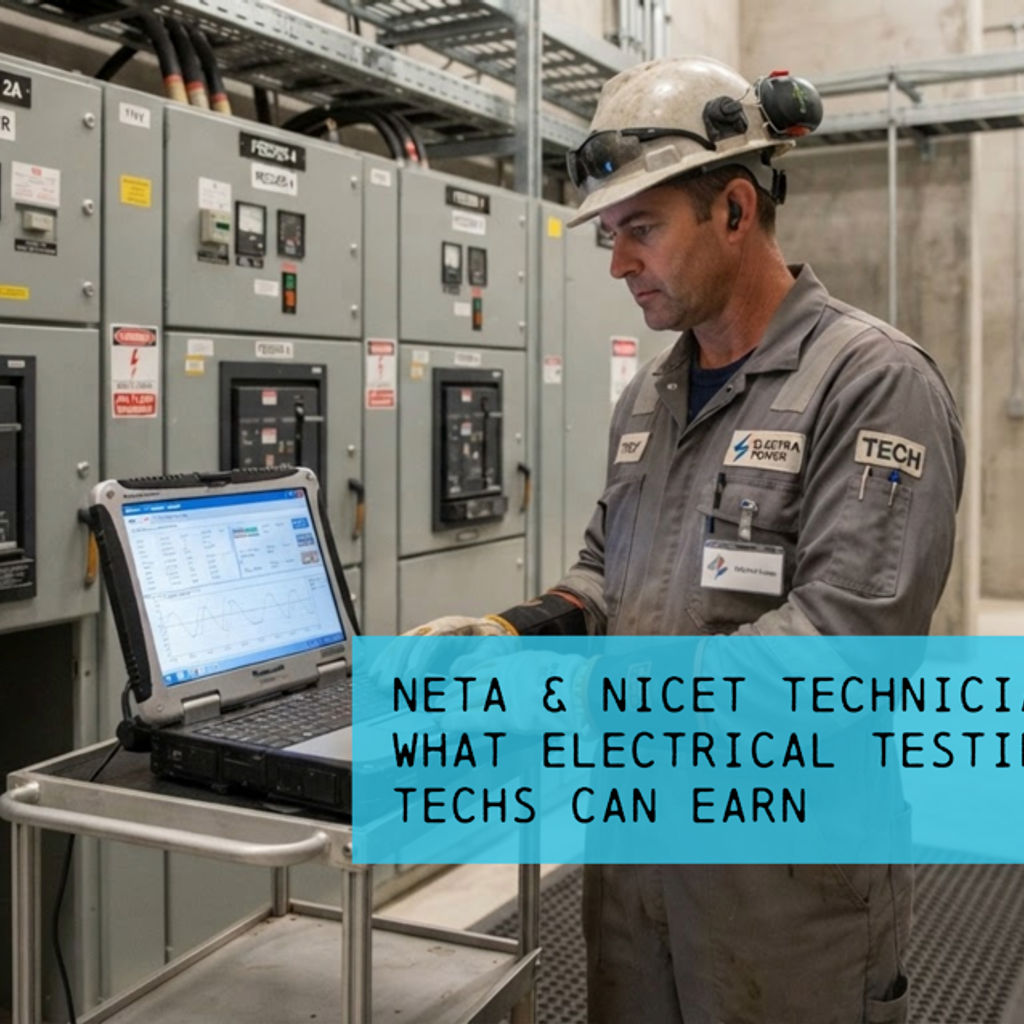



Electrical power testing is a relatively small part of the electrical industry, but it covers a wide range of equipment and skills. A testing technician may spend one project working on low-voltage breakers, another testing medium-voltage switchgear, and the next checking transformers, cables, protective relays, grounding systems, or control circuits.
As technicians gain experience, the work tends to become less about simply performing a test and more about understanding what the results mean, recognizing when something is wrong, and figuring out what needs to happen next.
That progression is one reason certifications such as the NETA Electrical Testing Technician (ETT) and NICET Electrical Power Testing (EPT) credentials often come up when people start looking at long-term earning potential in the field.
So what do these technicians actually make?
There is no official national salary for a NETA Level III technician or a NICET Level III technician. Federal wage statistics do not track workers by those certification levels, and employers do not all use the certifications the same way. Pay can change significantly based on experience, location, employer, travel, overtime, technical specialty, and how much responsibility the technician carries.
What we can do is look at federal wage data for closely related electrical work, compare that with the experience and responsibilities attached to NETA and NICET certification levels, and then look at actual job advertisements seeking technicians with those qualifications. The result is not a formal salary scale, but it gives a reasonable picture of the market.
There is no official NETA or NICET salary
One of the easiest mistakes to make when researching this career is looking for a chart that says NETA Level II earns one amount, Level III earns another, and Level IV earns another.
That kind of official national wage table does not exist.
The U.S. Bureau of Labor Statistics does not classify workers as NETA II, NETA III, NICET III, or NICET IV. The certification organizations define experience, training, and competency requirements, but they do not establish wages.
That means salary estimates have to be pieced together from several types of information.
Federal occupational data are useful for establishing what people doing similar power-system work earn. Certification requirements help show how the responsibilities change as a technician becomes more experienced. Job postings give us examples of what individual employers are willing to advertise for technicians with those qualifications.
None of those sources should be treated as a guaranteed salary.
A useful federal wage benchmark
One of the closest Bureau of Labor Statistics categories is Electrical and Electronics Repairers, Powerhouse, Substation, and Relay.
The category includes workers who inspect, test, repair, and maintain electrical equipment in generating stations, substations, and relay systems. That does not describe every electrical test technician, and not everyone in the BLS category holds a NETA or NICET certification, but there is enough overlap to make it a useful comparison.
According to May 2025 BLS data, the occupation included approximately 20,720 workers nationwide.
The national mean wage was about $48.44 per hour, or $100,760 per year. The median was approximately $49.53 per hour, or $103,020 per year.
The median is especially helpful because it represents the midpoint of the occupation. Half of the workers earned more and half earned less.
For comparison, the broader Electrical and Electronics Installers and Repairers category had a median annual wage of $74,490.
That does not mean the difference is caused by NETA or NICET certification. It does show that technicians working around substations, relays, generating equipment, and similar power-system equipment occupy a more specialized part of the electrical workforce.
Where NETA Level II fits
NETA identifies Level II as a Certified Assistant Technician.
A Level II technician has already moved beyond being completely new to the trade. NETA currently associates the level with two years of related experience, along with required safety training, electrical training, and successful completion of the Level II examination. The technician performs limited testing and service work but generally remains under the direct supervision of a Level III or Level IV technician.
In the field, that distinction matters.
A newer technician may know how to connect an insulation resistance tester, perform a contact resistance test, or follow a breaker test procedure. The Level II technician should be developing the ability to perform that work correctly and safely while building enough experience to understand what the equipment is doing.
There is still normally someone more experienced available to review the work, interpret questionable results, make higher-level decisions, and take responsibility for the job.
That is why Level II should not be viewed as an entry-level labor classification in the same sense as someone walking onto an electrical job for the first time.
Why Level III changes the job
NETA Level III is where the responsibility begins to change considerably.
NETA describes Level III technicians as capable of supervising lower-level technicians, performing and managing routine and moderately complex work, evaluating test data, maintaining records, taking responsibility for the safety of others, and performing electrical power switching. NETA associates the level with five years of related experience, subject to its education provisions.
Anyone who has spent time around field testing knows that this is a meaningful difference.
Running the test is often the straightforward part. The harder work begins when a result does not agree with previous data, a breaker operates slowly, a relay trips unexpectedly, or the equipment in front of you does not quite match the drawings.
At that point, the technician has to understand enough about the equipment and the system to determine whether the problem is with the test setup, the test equipment, the asset itself, or the assumptions made before testing started.
A strong Level III technician is also beginning to take ownership of the job rather than simply being assigned individual test tasks.
That can include reviewing drawings, coordinating work with other technicians, checking test data, handling switching, communicating with the customer, and making sure the work is documented correctly.
Those responsibilities help explain why advanced certification levels often appear in higher-paying job advertisements.
What Level IV represents
NETA Level IV is the Certified Senior Technician classification.
NETA describes Level IV technicians as capable of working independently, supervising large projects and multiple crews, performing complex investigations and tests, evaluating results, and preparing reports. The level is associated with 10 years of related experience, subject to the certification program’s education provisions.
By that point in a technician’s career, the value is usually much broader than knowing how to operate a test set.
A senior technician may be the person deciding how the job will be approached, determining what additional testing is needed after an abnormal result, coordinating multiple crews during an outage, or explaining to a customer why a piece of equipment should not be returned to service without further investigation.
The equipment may be the same switchgear, transformer, or relay that a developing technician is working on. The difference is the amount of judgment and responsibility being placed on the person doing the work.
NICET Electrical Power Testing follows a similar progression
NICET’s Electrical Power Testing program covers much of the same field.
NICET’s 2025 job analysis associates Level III with at least five years of electrical power testing experience. The work described at that level includes managing switching procedures, testing more complex multifunction equipment, analyzing test and equipment data, planning jobs, and leading teams.
At Level IV, NICET describes technicians working with complex relay and metering systems, evaluating test results and overall system performance, recommending corrective action, and leading larger multi-team projects.
The NETA and NICET programs are not identical, but the career progression is similar. As the technician advances, the work involves more analysis, more independence, and more responsibility for the overall job.
That is useful context when looking at salary advertisements because employers may accept NETA, NICET, or equivalent experience for the same position.
What an actual employer was offering
Federal wage statistics give us a broad benchmark. An actual job advertisement gives us a more direct look at what one employer was willing to pay for a particular skill level.
One position reviewed for this article was an ABM Industries opening in Richmond, Virginia for an Electrical Test Technician with NETA III or NICET preferred.
The advertised range was $52 to $67 per hour. The job involved testing electrical power distribution equipment, evaluating test data, completing field-service reporting, and approximately 25 percent travel. The posting also indicated that Level III and Level IV technicians would help train and supervise Level I and Level II personnel.
If those hourly rates are converted to 2,080 straight-time hours per year, the numbers look like this:
| Hourly rate | Straight-time annual equivalent |
|---|---|
| $52 | $108,160 |
| $55 | $114,400 |
| $60 | $124,800 |
| $65 | $135,200 |
| $67 | $139,360 |
Those calculations do not include overtime, bonuses, per diem, travel incentives, or other compensation.
They also represent one advertised position. They should not be read as the average salary for every NETA III or NICET III technician.
What the posting does establish is that an employer was willing to advertise more than $50 per hour for an experienced electrical testing technician with advanced qualifications.
NETA and NICET are not separate job markets
It is common to hear people ask whether NETA technicians make more than NICET technicians.
The available information does not support a broad claim that one credential automatically produces higher wages than the other.
Part of the confusion comes from the way the programs are structured.
NETA Certified Technicians work through NETA Accredited Companies. NETA explains that a prospective technician is employed by an accredited company and progresses through the certification process while working within that system. NICET certification is structured differently and is not tied to continued employment by a NETA Accredited Company.
Because of that difference, comparing the two certifications as though they were competing job titles does not tell us much about compensation.
In practice, an employer is going to care about the work the technician can handle. Someone who can independently test medium-voltage equipment, interpret questionable results, troubleshoot protection and control problems, perform switching, test protective relays, and assist with commissioning brings a different level of capability than someone whose experience is mostly limited to routine testing under supervision.
Leadership adds another layer. Being able to plan an outage, direct a crew, communicate with a customer, and take responsibility for the final results can affect a technician’s market value just as much as the certification printed on a résumé.
The ABM posting is a good example. The employer was willing to consider NETA III, NICET, or equivalent experience for the same job.
Certification levels are not pay grades
It would be convenient to publish a chart showing a fixed salary for every certification level, but the industry does not work that way.
Two technicians with the same certification can have very different backgrounds.
One may spend most of the year performing routine apparatus testing in a local service territory. Another may travel heavily, work outages, test protective relays, commission new substations, and troubleshoot complex control problems.
Both may technically hold the same certification level, but their jobs are not identical.
Geography also matters. A technician working around large data centers, utility projects, or major commissioning work may see different wages than someone working in a smaller industrial market.
Employer structure matters as well. Some companies pay higher base wages but have less overtime. Others rely heavily on travel, per diem, outage work, or extended schedules.
For that reason, the most defensible way to use salary data is to treat it as a market range rather than a guaranteed certification value.
What $50 to $67 per hour looks like annually
Hourly rates can be difficult to compare with salaried careers, so it helps to convert them into straight-time annual equivalents.
Using 2,080 hours per year:
| Hourly rate | Annual straight-time equivalent |
|---|---|
| $40 | $83,200 |
| $45 | $93,600 |
| $50 | $104,000 |
| $55 | $114,400 |
| $60 | $124,800 |
| $65 | $135,200 |
| $67 | $139,360 |
| $70 | $145,600 |
These are simple mathematical conversions, not predictions of annual income.
A field technician may work more or fewer than 2,080 paid hours in a year. Overtime, unpaid leave, bonuses, travel pay, and other compensation can change the final number substantially.
Overtime can change annual earnings quickly
Electrical testing work does not always happen during a normal Monday-through-Friday schedule.
Customers often want equipment tested when it can be taken out of service with the least impact on operations. That can mean nights, weekends, plant shutdowns, data-center maintenance windows, and long commissioning days.
For an hourly technician, that can make overtime a significant part of total compensation.
Consider a technician earning $65 per hour who works 50 hours in a week and receives time-and-a-half after 40 hours.
The first 40 hours produce $2,600. The overtime rate is $97.50 per hour, so another 10 hours adds $975. Total weekly earnings would be $3,575.
If that exact schedule continued for all 52 weeks, the mathematical annual total would be $185,900.
That is not a typical-salary claim. It assumes someone works 50 paid hours every single week of the year and receives time-and-a-half for every overtime hour.
The example is still useful because it explains why annual earnings reported by field technicians can sometimes look much higher than the base hourly rate suggests.
When comparing jobs, base pay by itself does not tell the whole story.
What tends to push technicians toward higher-paying work
Certification helps document a technician’s development, but the abilities behind the certification are what make the technician more useful in the field.
Protective relay work is one example. Connecting a relay test set is only a small part of the job. The technician also has to understand the protection scheme, drawings, relay logic, inputs and outputs, settings, and how the device should respond under different conditions.
Commissioning requires a similar step beyond individual equipment testing. Instead of asking whether one breaker or transformer passed its test, the technician has to understand whether the entire system works together properly.
Troubleshooting may be even more important.
A technician who can complete a procedure when everything behaves normally is useful. A technician who can stay with the problem when the breaker will not close, a CT circuit does not look right, a relay trips unexpectedly, or transformer results do not agree with previous data is much harder to replace.
Test-data interpretation develops the same way.
Newer technicians often focus on whether a reading is high or low. Experienced technicians start asking whether the result makes sense for that particular piece of equipment, how it compares with previous tests, what outside conditions may have affected it, and whether another test should be performed before reaching a conclusion.
That judgment comes from training, but a large part of it also comes from seeing enough equipment and enough problems in the field.
A certification does not automatically create a raise
This is probably the most important point for someone looking at the salary numbers.
Passing a certification exam does not suddenly make a technician worth a specific hourly rate.
The credential documents a certain level of knowledge and experience, but employers still have to look at what the technician can actually handle.
Two technicians can hold similar credentials while having very different levels of field ability.
One may be comfortable with routine test procedures but still need help when results become abnormal. Another may be able to review the one-line, plan the work, coordinate the outage, perform switching, test several types of equipment, troubleshoot unexpected results, write the report, and explain the findings to the customer.
The second technician gives the employer more options. That flexibility is part of what employers are paying for.
What this means for someone entering the field
Someone looking at this career from the outside may see the six-figure numbers and assume the certification itself is the shortcut.
It is not.
NETA Level III and NICET Level III are associated with years of experience because technicians need time around real equipment before they can reliably handle more complicated work.
A new technician first has to learn the basics: electrical safety, test equipment, electrical theory, drawings, circuit breakers, transformers, cables, grounding systems, protective devices, and the test procedures used on each type of equipment.
Then comes the part that cannot be learned entirely from a book.
Field equipment is not always clean, new, labeled correctly, or wired exactly the way the drawing suggests. Previous test data may be missing. The customer may not know the history. A breaker may have been modified years ago. A control circuit may contain changes that never made it back onto the print.
Learning how to work through those situations is what turns basic testing knowledge into field judgment.
Over time, the technician moves from asking what to do next to being the person the crew calls when nobody is sure what to do next.
That is where the career starts to change.
The bigger career opportunity
The strongest conclusion from the available salary information is not that a particular certification guarantees a particular wage.
The better takeaway is that electrical power testing offers a technical career path where experienced technicians can reach compensation well above the broader electrical workforce.
The BLS benchmark for powerhouse, substation, and relay repairers shows a median wage of approximately $103,020 per year.
The ABM example shows an advanced electrical testing position advertised at $52 to $67 per hour, which works out to roughly $108,000 to $139,000 per year at straight time.
Those figures do not prove that every NETA or NICET technician will earn six figures.
They do show that the opportunity exists for technicians who build the experience and capability required to work independently on complex electrical power systems.
For someone planning a career in the field, the better question is not simply how much a NETA or NICET certification is worth.
It is what additional work you will be trusted to perform once you reach that level.
That is usually where the earning potential starts to follow.
Assumptions and methodology
This salary analysis has several limitations that are worth keeping in mind.
The BLS category used here is an occupational benchmark, not a certification dataset. Workers classified as Electrical and Electronics Repairers, Powerhouse, Substation, and Relay may perform work similar to electrical testing technicians, but they do not all hold NETA or NICET certifications. The reverse is also true.
Job advertisements show what an employer was prepared to advertise for a particular opening. They do not show the final salary accepted by the person hired or what existing employees at the company earn.
The certification levels in this article are used to explain career progression. They should not be interpreted as nationally standardized wage grades.
Annual salary equivalents use 2,080 hours, based on 40 hours per week for 52 weeks. Overtime examples assume time-and-a-half unless otherwise stated.
Finally, higher advertised wages should not be confused with national averages. Compensation can be influenced by geography, specialized technical skills, travel, commissioning work, supervisory responsibility, and the type of customers or facilities being supported.
The information in this article should therefore be treated as a snapshot of the 2025–2026 U.S. labor market rather than a permanent salary scale.
References and sources
U.S. Bureau of Labor Statistics. Occupational Employment and Wage Statistics, May 2025. National employment and wage data for Electrical and Electronics Repairers, Powerhouse, Substation, and Relay.
U.S. Bureau of Labor Statistics. Electrical and Electronics Installers and Repairers, Occupational Outlook Handbook.
InterNational Electrical Testing Association (NETA). Technician Certification.
InterNational Electrical Testing Association (NETA). Accreditation Overview.
InterNational Electrical Testing Association (NETA). Exam Preparation.
ANSI/NETA ETT-2026. Standard for Certification of Electrical Testing Technicians for Electrical Power Equipment & Systems.
National Institute for Certification in Engineering Technologies (NICET). 2025 Electrical Power Testing Job Analysis Surveys.
ABM Industries. Electrical Test Technician – NETA III or NICET Preferred, Richmond, Virginia. The reviewed advertisement listed compensation of $52 to $67 per hour and approximately 25 percent travel.
Research and compensation information reviewed for this article was current as of September 2026. Job postings, certification requirements, and market wages can change.

