
Waratah super battery transformer failure: what happened and why it matters
The Waratah Super Battery is a large battery energy storage system in New South Wales, Australia. It was built to help the power grid stay stable when demand changes quickly or when part of the system has a problem. A simple way to picture it is like a shock absorber for the grid. It helps smooth out sudden changes instead of letting the system take the full hit.
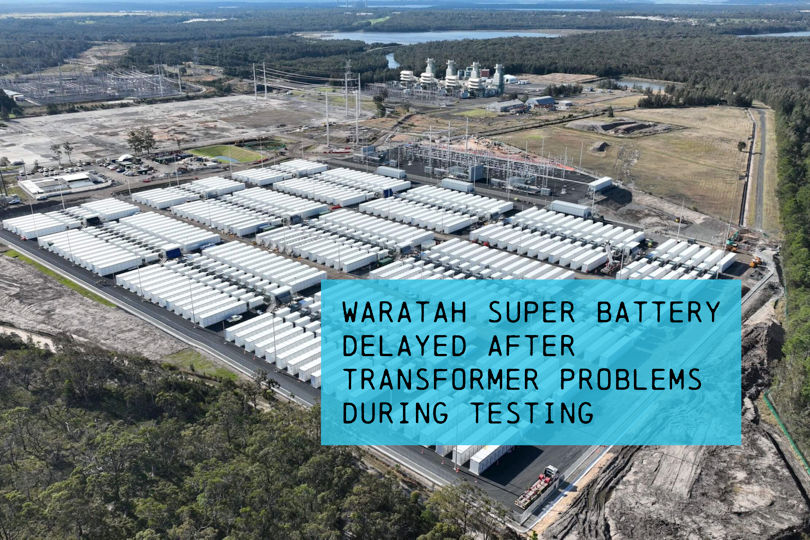
The project recently ran into trouble during final testing. Engineers found problems in two of the three transformers at the site while checking whether the system could safely operate at its full 850 MW design output. Because of that, the battery is not running at full power right now. It is still operating at 350 MW while engineers inspect the damage and decide whether the affected transformers can be repaired or replaced.
What the Waratah Super Battery does
This battery is not just sitting there as backup power. It stores electricity and can send that electricity back into the grid very quickly when needed. That fast response is a big reason grid-scale batteries are becoming more common. As more wind and solar power are added to power systems, grid operators need equipment that can react quickly when generation changes with weather or time of day.
That is the job of the Waratah Super Battery. It helps support the grid during stressful moments. Even when power conditions change fast, the battery can respond in seconds.
What went wrong during testing
The problem showed up during commissioning. Commissioning is the stage where engineers test and check a system before it enters normal full service. In this case, they were moving the battery toward full operation and checking whether it could safely deliver its full output. During that work, they found transformer problems. Reports said at least one transformer suffered very serious damage.
That discovery forced the project to reduce output. The site is still online, but only at part of its planned capacity. So the project is still helping the grid, just not as much as it was designed to.
Why the transformers matter so much
When people think about a huge battery project, they usually think about the battery cells or containers first. But the support equipment matters just as much. In many cases, it matters more.
A transformer changes voltage so electricity can move properly between the battery system and the grid. The battery may store and process energy at one voltage, while the grid needs power delivered at another. The transformer makes that connection possible. If the transformer is damaged, the battery cannot fully do its job, even if the batteries and inverters are still working.
This is an important lesson for beginners in power systems. The most visible part of a project is not always the part that causes the biggest delay. A project can be limited by support equipment such as transformers, breakers, protection devices, controls, or cables.
Why testing before startup matters
This event is a good example of why testing matters. Final testing is not just a box to check. It is where engineers prove that the system can operate safely and correctly under real conditions.
Testing helps teams find problems before the public and the grid depend on the project every day. If these transformer issues had only been found after full service began, the result could have been worse. A failure during normal operation could have caused a larger outage, damaged more equipment, or increased safety risk.
Testing also protects reliability. A large energy project is only as dependable as its weakest major part. Even if the batteries, controls, and inverters are working well, the project is not ready for full service if the transformers are not.
Key electrical terms to know
A transformer is a device that changes voltage so electricity can move through the power system safely and efficiently.
Commissioning is the process of testing and checking equipment to make sure it is ready for normal use.
Grid synchronization means matching a new system to the grid’s electrical conditions, such as voltage and frequency, before it runs fully in parallel with the system.
A battery energy storage system, or BESS, is a large battery installation that stores electricity and sends it back out later when needed.
Why the site still matters at reduced output
Even with this equipment problem, the Waratah Super Battery is still helping the grid. At 350 MW, it is still providing support instead of dropping fully offline. That matters because it shows that a large battery site can still provide some value even when major equipment has been damaged.
It also shows why staged operation can be useful during large infrastructure projects. Sites like this often move through testing, limited operation, and then full output. That step-by-step process helps teams catch problems earlier and lowers the chance of a bigger failure later.
What this failure teaches about grid infrastructure
This is not only a story about one battery project in Australia. It also shows a broader truth about modern power systems. Adding more batteries, solar, and wind does not remove the need for strong basic electrical infrastructure. In many ways, it increases that need.
Modern energy projects still depend on reliable transformers, switchgear, protection systems, controls, and cables. All of those parts have to work together. If one major piece fails, the whole project can be limited.
For new technicians, that is one of the clearest lessons here. New energy technology still depends on basic electrical equipment and good engineering practice. Careful design, proper testing, solid protection, and ongoing maintenance still matter.
Why this transformer failure matters
The Waratah Super Battery was built to support the grid in New South Wales, and it is still doing part of that job. But the transformer failure during testing shows how even an advanced battery project can be limited by trouble in critical support equipment.
The good news is that the issue was found during testing instead of after full commercial operation began. The site is still online at reduced output, still helping the grid, and still has a path toward recovery once the transformer issue is resolved. For anyone learning about electrical systems, the main takeaway is simple: testing matters, and support equipment matters just as much as the technology that gets most of the attention.


