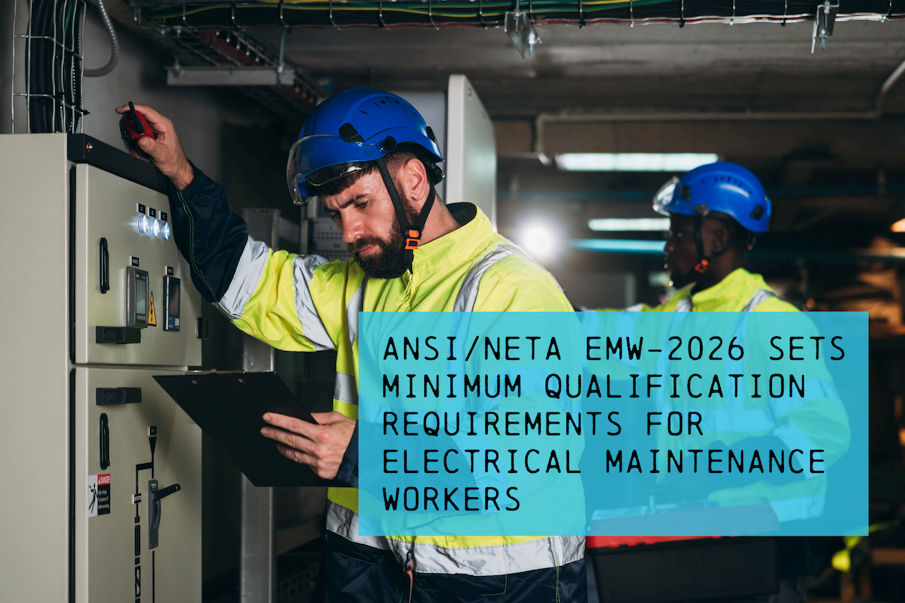
NETA has a new ANSI-approved standard aimed at one thing: making “qualified maintenance worker” a defined, documentable requirement instead of a vague label.
That standard is ANSI/NETA EMW-2026, titled Standard for Qualification of Electrical Equipment Maintenance Workers for Electrical Power Equipment & Systems. (netaworld.org)
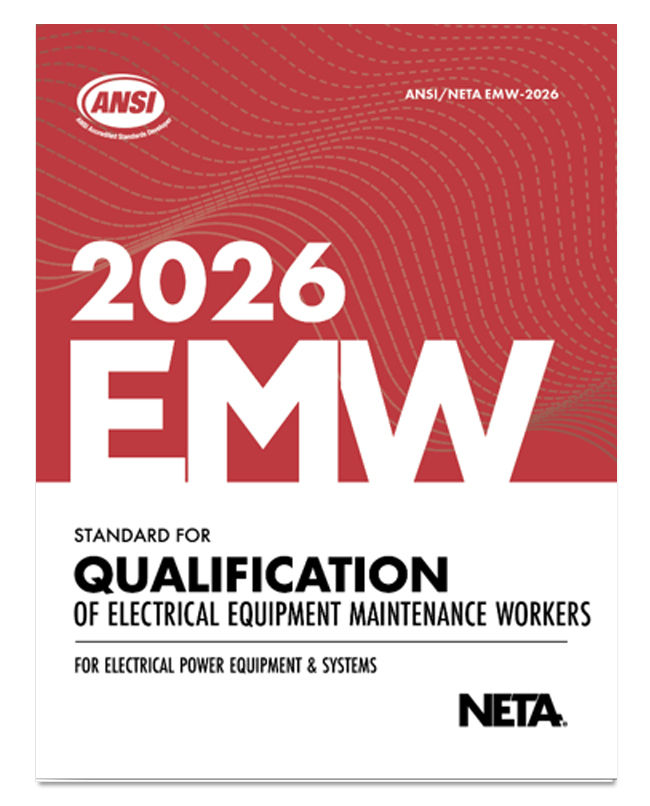
What ANSI/NETA EMW-2026 is
EMW-2026 sets minimum requirements for a Qualified Electrical Equipment Maintenance Worker (QEMW) performing maintenance on electrical power equipment and systems. In NETA’s public scope language, it does three main things:
- Establishes minimum requirements for a QEMW
- Sets minimum training and experience requirements and criteria for documenting qualifications
- Specifies requirements for an independent and impartial qualification system for electrical equipment maintenance workers
NETA also describes EMW-2026 as developed to support implementation of NFPA 70B (Standard for Electrical Equipment Maintenance).
Why EMW-2026 matters
The testing side of the industry has long relied on well-known specifications for what to test and how to document results. Maintenance work, especially hands-on servicing and condition-based corrective work, has often been less consistent in how “qualification” is defined and proved.
EMW-2026 is designed to close that gap by making qualification something that can be supported with a consistent set of minimum criteria and documentation, and by requiring a qualification system that is not purely internal.
Release timeline (dates you can plan around)
NETA’s EMW-2026 page provides a clear public announcement:
- ANSI approval effective: January 6, 2026
- Pre-sale: around the end of January 2026
NETA’s standards development page adds that pre-sale begins end of January for the bound version, and shows the project’s approval date again as January 6, 2026.
Price (publicly posted)
An ANSI Standards Action notice for the EMW project lists: “Single copy price: $495.00.”
(That notice is tied to the BSR/NETA EMW-2026 project listing and reflects what ANSI published for the proposal stage. NETA may display final storefront pricing separately once the standard is on sale.)
Who it impacts first
Facility owners and operators
EMW-2026 gives owners a straightforward way to specify minimum worker qualification for maintenance activities tied to power equipment and systems. NETA positions EMW-2026 as supporting NFPA 70B implementation, which is exactly where many owners are tightening maintenance programs and the supporting paperwork.
Maintenance contractors and service divisions
If your work includes planned maintenance, servicing, cleaning, exercising, condition checks, and corrective maintenance on power distribution equipment, EMW-2026 creates a clean requirement that can show up in scopes and procurement language: minimum qualifications, training/experience documentation, and an independent qualification system.
Technicians (in-house and contractor)
The practical shift is that “qualified” increasingly needs to be provable—training records, verified experience, and consistent documentation—rather than based on reputation or seniority alone. EMW-2026 is explicitly built around qualification criteria and qualification documentation.
What it means for technicians day to day
1) Qualification paperwork becomes part of the job
EMW-2026 is structured around minimum training/experience requirements and criteria for documenting qualification, plus an independent qualification system. That points to more emphasis on maintaining records that follow you site to site: training, task exposure, and proof you meet defined requirements.
2) Safety competency stays central
NETA’s QEMW Detailed Content Outline (for the QEMW exam program in the same ecosystem) weights Safety at 27% of the overall score and includes items like approach boundaries, establishing an electrically safe work condition (including LOTO), PPE/safety tools, and interpreting incident energy/shock hazard labels.
Even if your employer is not pushing the exam, that outline reflects what NETA expects a “qualified maintenance worker” to understand and apply on real sites.
3) Fundamentals and equipment knowledge get tested in the real world
That same QEMW outline assigns 27% to Electrical Maintenance Fundamentals and 46% to Electrical Equipment, covering core tasks like visual inspection, cleaning methods, mechanical servicing, basic electrical tests (for example insulation resistance and connection resistance where applicable), evaluating results, and verifying system parameters before/after maintenance.
Translated into field reality: technicians who can do clean mechanical work and understand what the measurements and labels mean are the technicians customers rely on during short outage windows.
4) Documentation quality starts separating crews
When standards move qualification toward documented requirements, reporting tends to follow. The technicians who write clear “as found / as left” notes, capture condition evidence, and communicate what still needs attention are easier to staff on critical sites—because their work is defensible when someone asks for the record.
How to prepare before the standard is in your hands
Build a simple “qualification packet”
Start a folder (digital or physical) that you can hand to a supervisor or safety manager:
- Safety training records (NFPA 70E training, LOTO training, site-specific requirements)
- Equipment- or OEM-specific certificates
- A one-page summary of maintenance experience (equipment types, voltage classes, typical tasks)
- Any relevant credentials already held
Use the QEMW outline as a skills checklist
If you want a practical study guide without guessing what matters, the QEMW Detailed Content Outline is already public and breaks expectations into Safety, Fundamentals, and Equipment domains with specific bullets.
Tighten your closeout notes
Make it a habit to answer, in plain language:
- What was maintained/inspected?
- What condition was found (and what evidence supports it)?
- What was corrected?
- What remains open, and what is the recommended next step?
That style of documentation travels well across customers, supervisors, and audits.
A short toolbox-talk summary
- ANSI/NETA EMW-2026 is an ANSI-approved standard that defines minimum requirements for Qualified Electrical Equipment Maintenance Workers (QEMW), including training/experience documentation and an independent qualification system. (netaworld.org)
- NETA ties EMW-2026 directly to supporting NFPA 70B implementation. (netaworld.org)
- NETA states ANSI approval was effective January 6, 2026, with pre-sale around the end of January 2026. (netaworld.org)
- An ANSI Standards Action notice lists a single-copy price of $495.00 for the EMW project listing. (share.ansi.org)
- For technicians, the direction is clear: qualification becomes more document-driven, and safety plus fundamentals remain the backbone of being considered “qualified.”