
Plan your study.
Choose a four-week, two-week, or final-week schedule based on your starting knowledge and available study time.
Open the study plans →Book companion · 2026–2027 edition
NICET® Electrical Power Testing Level III
Independent Study Guide · Bill Monroe
Keep your preparation moving. Plan your review, practice Level III reasoning, check book updates, and keep official NICET information close.
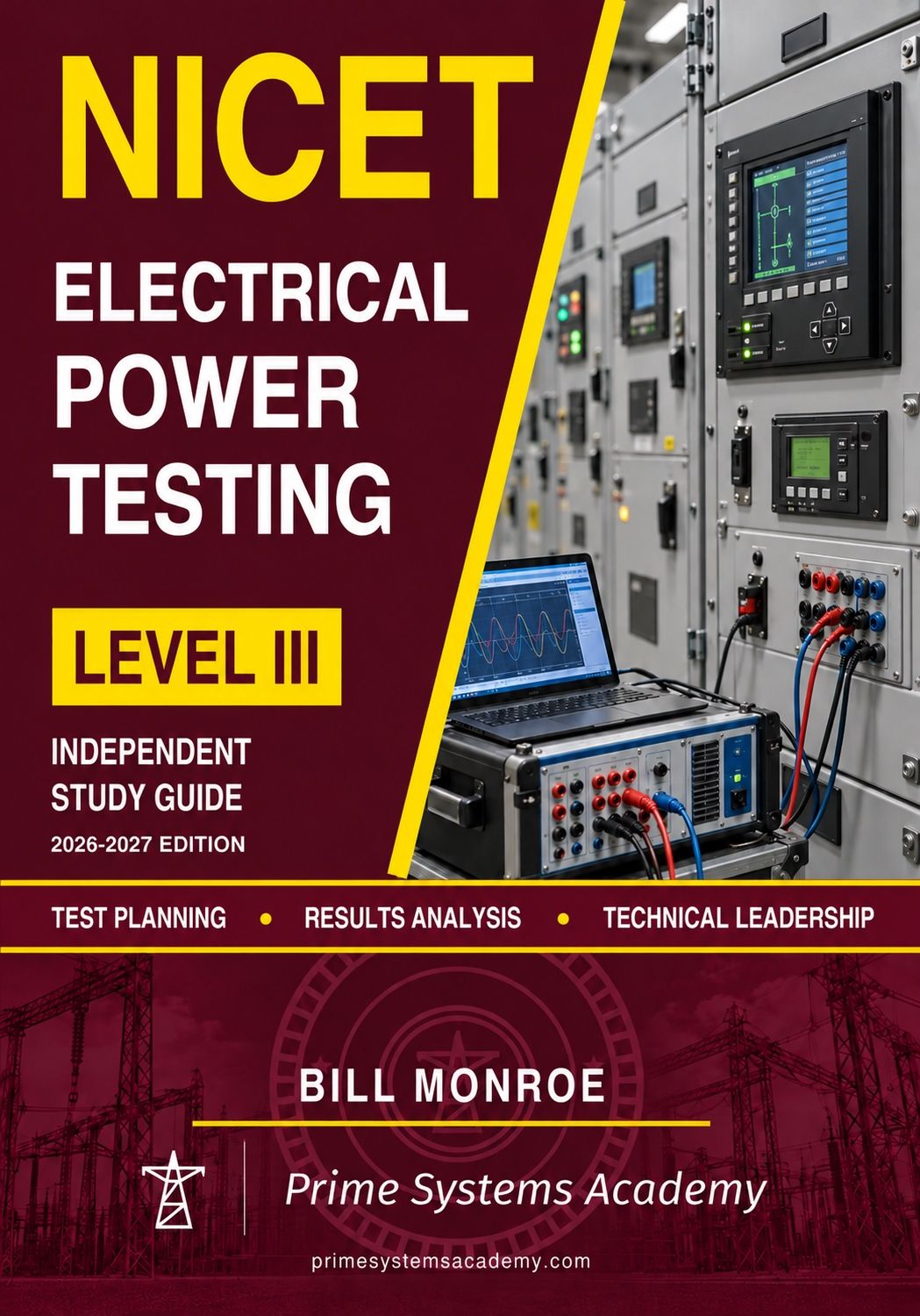
A companion to your copy of the book
Start here
Keep the guide nearby and use this page to support your next study session.
Choose a four-week, two-week, or final-week schedule based on your starting knowledge and available study time.
Open the study plans →Use short recall prompts to revisit test validity, result interpretation, functional verification, and protection-and-control reasoning.
Try quick recall →Check edition-specific corrections, find official NICET information, or send a question about the book.
View book updates →Based on “How to use this book”
These suggested schedules apply the book’s sequence: technical review, targeted repair, and timed practice. Select a plan to see the study sequence.
Adjust the pace to your starting knowledge and available hours. Leave study sessions between practice exams. If a major gap remains, give it more time instead of treating the schedule as a readiness test.
Read About NICET Level III and assess your coverage of all seven official domains. Begin the technical chapters in sequence: worksite safety, job planning, power-system concepts, grounding, and electrical documentation. Complete the knowledge checks and record missed or guessed answers.
Continue through test-result validity, serviceability, major-equipment testing, instrument transformers, relays, SCADA, functional testing, and protection-and-control troubleshooting. Finish the technical chapters and knowledge checks. Track the concepts and assumptions that still need work.
Work through the Final Review and Quick Reference section. Take Practice Exam 1 in an uninterrupted 125-minute session for all 102 questions, without the book or answer key. Review missed answers and uncertain correct answers, then return to the relevant technical sections.
Use focused study sessions to address the gaps found in Exam 1. Take Practice Exam 2 after that review, and reserve Practice Exam 3 for a later check after additional study. Rework calculations and scenario decisions from the given information; do not rely on remembering an answer letter.
Use the current Level III outline and your chapter-check results to identify the largest gaps across all seven domains. Review the relevant technical chapters, including topics outside the equipment you work with most often.
Continue focused technical review and use the Final Review and Quick Reference section to connect topics. Take one 102-question practice exam in 125 minutes early enough to act on the results. Mark guesses as well as missed answers for follow-up.
Group errors by topic and cause: missing knowledge, unit or ratio errors, misread conditions, or unsupported assumptions. Revisit the relevant chapters and sources. Explain the method or decision without the answer choices, then apply it to another example.
Use another practice exam only after targeted review and when enough time remains to study its findings. Return to unresolved concepts and confirm current NICET candidate instructions. Covering every practice form is less useful than correcting an important misunderstanding.
Start with the current outline, your weakest chapter checks, and previous practice results. Use the Final Review and Quick Reference section to locate gaps, then read the corresponding technical discussions. Take one timed exam early enough to review and act on its findings.
Review missed and uncertain correct answers. Rework calculations with compatible units, distinguish valid abnormal data from invalid measurements, and explain the limits of each test or comparison. Check the source context when an explanation depends on a particular requirement.
Revisit the remaining gaps across planning, test evaluation, equipment, theory, documentation, and protection and control. Use another practice form only if you can review its results. Confirm current testing instructions directly with NICET; no practice percentage guarantees a pass.
From Final Review and Quick Reference
Explain your answer first, then select a prompt to reveal the review note. Return to the technical chapter when the reasoning needs more work.
An invalid result has a setup, method, or recording problem that prevents the intended conclusion. A valid abnormal result remains meaningful after those concerns are resolved. Correcting a comparison does not repair the equipment.
Confirm equipment identity, test boundary, method, units, and relevant conditions such as temperature, test voltage, duration, tap, and operating position. Keep raw data and document any justified correction. A changed setup can break a trend.
No. A satisfactory result on one characteristic does not cancel a verified abnormal condition elsewhere. Serviceability considers the supported condition, required duty, applicable criteria, and unresolved limitations.
It verifies only the portions included in the stimulus and observation boundary. Sensors, wiring, control circuits, or final devices outside that boundary still require the applicable functional verification.
Its programmed CT scaling can be wrong even when the physical secondary measurement is correct. Check the actual winding and ratio along with the relay configuration; ratio alone also does not prove correct phase assignment.
No. Ground resistance, soil resistivity, bonding, fault-current paths, and step or touch potentials describe different aspects of the system. One measurement alone cannot establish every protective-response or personnel-safety condition.
No. Trace the point from its field source through acquisition, scaling, mapping, and display. Confirm identity, units or state meaning, and data freshness. A forced display value can bypass upstream portions of the path.
It distinguishes the remaining explanations for the observed behavior. Choose the next check from the evidence and approved work boundaries, state the expected result, and document what the observation establishes and what remains unresolved.
After a practice session
Use this routine after a chapter check or practice exam. Review incorrect answers and correct answers that depended on a guess. The cause of the error tells you what to study next.
Keep a simple tracker: domain, concept or decision, cause of the error, chapter or source to revisit, and status: Revisit, Improving, or Explained independently.
Book updates & corrections
Level III · 2026–2027 edition
Entries identify the affected Level III edition and the chapter, section, or practice question. Use the section heading when print and eBook pagination differ.
| Date added | Chapter / section | Correction or clarification |
|---|---|---|
| No correction entries have been added to this page yet. | ||
Something look incorrect or unclear? Include the Level III edition, chapter or practice-exam number, and passage so the issue can be reviewed.
Report a book issue →Official NICET information
Use NICET’s own pages to check the current outline, preparation references, testing policies, and certification requirements.
Use NICET’s published outline to check coverage across the Level III responsibilities and task areas.
Open outline ↗Find the Selected General References NICET identifies for Level III exam preparation.
Open reference list ↗NICET’s Level III reference list states that references are not permitted in the test center. Confirm the current instructions before your appointment.
View policy ↗Check current exam information and the separate certification requirements. Study progress and practice scores do not establish eligibility.
Visit NICET ↗Official links checked November 1, 2026. Confirm current NICET information before applying or testing. This guide and its companion materials are independent study resources.
Reader help
Use Prime Systems Academy’s support form for a Level III book question, a possible correction, or help finding a companion resource.
Open reader support →This Level III companion material was independently developed by Prime Systems Academy. Prime Systems Academy and Water Rock Media LLC are not affiliated with, sponsored by, approved by, or endorsed by NICET. The book and companion resources support study; they do not replace approved field procedures, establish certification eligibility, or guarantee an examination outcome.
© 2026 Water Rock Media LLC. All rights reserved.

