
Plan your study.
Choose a 30-day, 14-day, or final-week schedule based on your available time and current understanding.
Open the study plans →Book companion · 2026–2027 edition
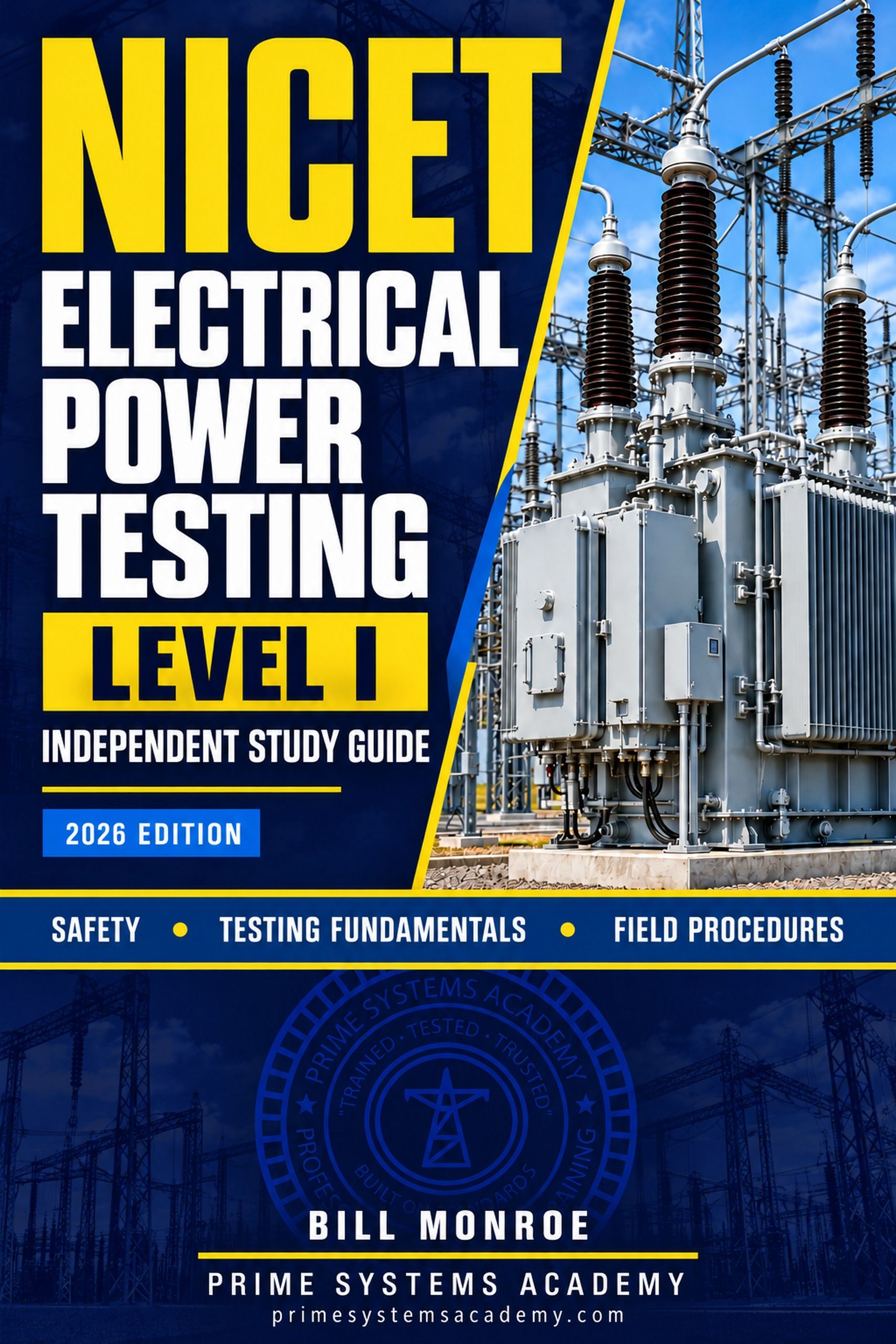
NICET® Electrical Power Testing Level I
Independent Study Guide · Bill Monroe
Keep your preparation moving. Use the study plans, refresh key concepts, check book updates, and find the official information you need.
A companion to your copy of the book
Start here
Keep the guide nearby and use this page to support your next study session.
Choose a 30-day, 14-day, or final-week schedule based on your available time and current understanding.
Open the study plans →Use a short set of recall prompts to revisit electrical quantities and common test-instrument purposes.
Try quick recall →Check edition-specific corrections, find official NICET information, or send a question about the book.
View book updates →From Chapter 2
These condensed schedules follow the plans in the book. Select a plan to see the study sequence.
Adjust the schedule to your work and starting point. Direct extra attention toward weak areas, and use your results to decide when more preparation is needed.
Classify all six domains as Strong, Needs review, or Weak. Start the technical review with Chapter 3, give extra attention to weak areas, use short practice sets, and begin a weakness tracker.
Continue through the technical chapters. Review missed questions after each area, use recall practice where helpful, and consult references for specific gaps. Aim to review all six domains at least once.
Revisit recurring errors. After completing the technical review, take Practice Exam 1 and analyze the results by topic. Add newly discovered gaps to your tracker and introduce mixed practice as those gaps improve.
Use Chapters 9 and 10 for condensed and final review. Take Practice Exam 2 after targeted study. Reserve Practice Exam 3 for later in this period if your schedule supports it, and review the concepts behind your missed answers.
Assess all six domains immediately. Begin with the chapters connected to your weakest topics and use short practice sets to check that initial assessment.
Work through Chapters 3–8, prioritizing Weak and Needs review areas. Track missed concepts and give each domain adequate coverage while directing extra attention to recurring errors.
After the main technical review, take a full practice exam. Review every missed question, return to the relevant chapters, and use targeted questions to work on recurring problems.
Use Chapters 9 and 10. Focus on remaining weaknesses, commonly confused concepts, formulas, units, equipment recognition, and missed-question patterns. Use further broad practice when it helps confirm improvement.
Use previous practice results and your weakness tracker to select priorities. Revisit the related technical chapters and use targeted questions to check whether your understanding has improved.
Use Chapter 9 for condensed formulas, units, terminology, equipment, instrument purposes, and other reminders. Review missed questions and use official references to clarify specific concepts.
Follow Chapter 10. Look for repeated error patterns. If another full practice exam fits your sequence, use it diagnostically and devote time to the missed concepts. Keep attention on topics that still produce mistakes.
Starter review · Chapter 9
Try answering first, then select a prompt to reveal the answer. Return to the chapter when a concept needs more work.
The ampere (A).
The number of complete AC cycles each second. Frequency is measured in hertz (Hz).
kW describes power. kWh describes energy transferred or used over a period of time.
A low-resistance ohmmeter.
It applies DC test voltage and measures the high resistance of electrical insulation.
A phase rotation meter identifies phase sequence on a three-phase system.
The relationship between transformer windings.
Ambient temperature and relative humidity.
After a practice session
Use this routine from Chapter 2 after practice. A total score is a starting point; the patterns tell you what to revisit.
Keep a simple tracker: domain, specific concept, what you missed, review needed, and status: Still weak, Improving, or Comfortable.
Book updates & corrections
2026–2027 · First edition
Entries identify the affected edition and the chapter or section. Use the section heading to find the passage when print and eBook pagination differ.
| Date added | Chapter / section | Correction or clarification |
|---|---|---|
| No correction entries have been added to this page yet. | ||
Something look incorrect or unclear? Send the edition and location so the passage can be reviewed.
Report a book issue →Official NICET information
Use NICET’s own pages to check the current outline, preparation references, testing policies, and certification requirements.
Review the published Level I responsibilities, tasks, knowledge, and skills.
Open outline ↗Find the reference list NICET provides for Level I exam preparation.
Open reference list ↗Check the Electrical Power Testing entry on NICET’s exam-reference policy page.
View policy ↗Check current exam information and the requirements for certification.
Visit NICET ↗These links lead to NICET’s website. Check its current information before registering for or taking your examination.
Reader help
Use Prime Systems Academy’s support form for a book question, a possible correction, or help finding a companion resource.
Open reader support →
